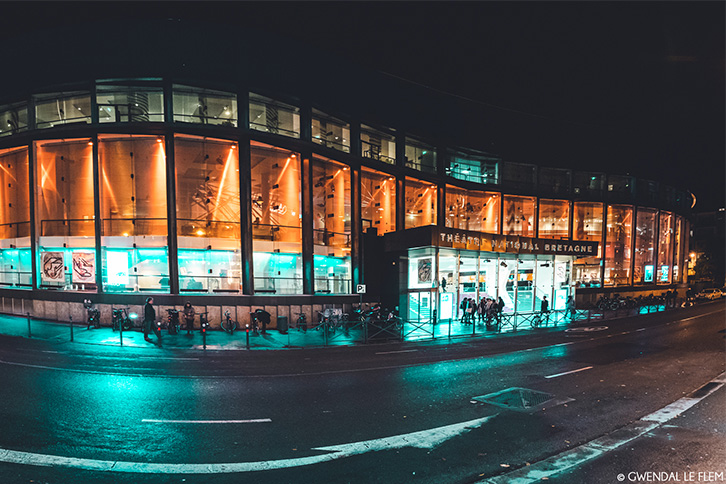


Théatre National de Bretagne - Rennes (France)


Six cities, one project, the theatre in common
Europe was initially conceived as a liberal common market, although it is in a bit of a crisis at the moment!
Artists do not like to see it that way. As the Renaissance demonstrated, they are wonderful ambassadors of humanity, capable specifically of reflecting on certain taboo issues and participating in building a Europe that is artistic, cultural, democratic, social, pacifist and open to other countries and continents.
Of course there are major decision-makers, ultra-liberal leaders and some communicators who would actually like to declare that theatre is a dead art form, just as there are dead languages.
However this involves forgetting that European theatre started in Greece, at the same time as philosophy and democracy.
This involves ignoring the dynamism of the theatrical scene in Europe which intends to play its part in a policy based on “the flowering of the cultures of the Member States, while respecting their diversity and at the same time bringing the common cultural heritage to the fore”.
The Théâtre National de Bretagne (Rennes - France), the Théâtre de la Place (Liège - Belgium), the Emilia Romagna Teatro Fondazione (Modena - Italy), the Schaubühne (Berlin - Germany), the Centro Cultural de Belém (Lisbon - Portugal) and the Tutkivan Teatterityön Keskus (Tampere - Finland) and intend to develop this essential intercultural dialogue through the mobility of artists and works, and the circulation of arts administrators and cultural productions.
The managers of these institutions have decided to combine their capacities for supporting new works and establish an agreement for cultural cooperation to develop European creation, research and training. Looking outwards too, this device is opening itself up to partnerships with Latvia (director Alvis Hermanis) and Poland (director Krzysztof Warlikowski).
Cultural cooperation must encourage linguistic diversity. Theatre, even more than visual arts or dance, is supportive of what is at stake here. Particular attention is being focused on working in the original languages and in translation, not just when works are being performed but on other occasions when audiences are present too.
In its final phase, this collaboration is the fruit of two years of work and discussions between the managers and teams. However these institutions already shared links and common ground before the network was set up. Indeed, several managers in the six founding organisations already knew each other and most have worked together before. All of them share the desire for a concerted joint effort.
Starting in 2008, this daring theatrical project is for a period of five years.
The project that has been put together is called Prospero.
The meetings between managers have taken place in accordance with their elective affinities. Their shared common values and convergent aesthetic intuitions have enabled this joint project to get off the ground.
The kind of theatre being considered here is a poetic and political theatre which favours a common education of critical judgment. Prospero serves a theatre of art, that is to say a theatre of meaning that has joy and aesthetics running through it.
This has to produce bold creations, propositions that are personal and sincere, works in the process of being created and at the heart of contemporary debates.
Reason and imagination must be combined. In the words of Edward Bond: “Only then is humanness a possibility”. This combination is a place of confluence and sharing. An innovatoire alongside the conservatoires.
Thanks to its numerous encounters with audiences in different countries during its many circulations and in the course of exchanges between professionals in the world of art and culture, those in charge of policy, researchers and educationalists, this project is concrete proof of a community spirit, revealing a Europe in action, involved in creation and committed to sharing it.